149 $
Description
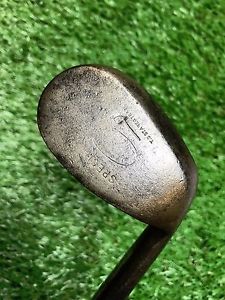
Here is a very early T Stewart, St Andrews Scotland, hickory shaft rut style niblic, circa 1900’s. This is a smoot face club. The markings on the head very faint but somewhat visible. Its condition is good and it shows very little ware and marks. The club was lightly cleaned and the head was carefully hand-polished to remove the oxidation and years of neglect. Tom Stewart
St Andrews
Thomas Stewart, born in St Andrews in 1862, made irons with his own name on them and, indeed, for most of the top makers and players of his time (Auchterlonie, Robert T Jones, Harry Vardon etc.) Stewart was one of the most respected club makers in Scotland and his early irons were used by Old Tom Morris himself. He served an apprenticeship with Robert White and started in business on his own in the mid-1890s in Market Street, St Andrews, but also took over premises in The Pends where Robert White had his business. For quite some time irons were forged in The Pends then taken across to Market Street for finishing. St Andrews is not huge but that could not continue as the business expanded so he took premises in Greyfriars Gardens before moving to the address in Argyle Street where the business remained until his death and beyond.His own maker's mark was a clay pipe (for the sound business reason that his brother, an engineer in Dundee, smoked such a pipe) but you will also see a stylised spider-like star on heads which he himself rejected on grounds of quality but sold on to other makers. In 1905 he registered the pipe mark as a trademark and post-1905 clubs contain this trademark information below the pipe.In addition to his clubs his patented iron hole liners and cups were used on the Old Course at St Andrews.He retired around 1930, his business carried on by his sons, Thomas, John and Malcolm and he died in 1931. His obituary in the Dundee evening paper claims he was the first man to make a matched set of clubs. My understanding has always been that honor went to George Nicoll of Leven with the Indicator series in 1926 but I will check it out.The head measures a lengthy 3 inches and the
The shaft is the original and the grip is also, in good condition with normal wear and tear, see photos. The head is tight to the hose may have re-set and pinned. There is not movement when you twist it, and no cracks to the hosel. This club would make an excellent players club or a great addition to anyone’s Stewart collection. St Andrews
Thomas Stewart, born in St Andrews in 1862, made irons with his own name on them and, indeed, for most of the top makers and players of his time (Auchterlonie, Robert T Jones, Harry Vardon etc.) Stewart was one of the most respected club makers in Scotland and his early irons were used by Old Tom Morris himself. He served an apprenticeship with Robert White and started in business on his own in the mid-1890s in Market Street, St Andrews, but also took over premises in The Pends where Robert White had his business. For quite some time irons were forged in The Pends then taken across to Market Street for finishing. St Andrews is not huge but that could not continue as the business expanded so he took premises in Greyfriars Gardens before moving to the address in Argyle Street where the business remained until his death and beyond.His own maker's mark was a clay pipe (for the sound business reason that his brother, an engineer in Dundee, smoked such a pipe) but you will also see a stylised spider-like star on heads which he himself rejected on grounds of quality but sold on to other makers. In 1905 he registered the pipe mark as a trademark and post-1905 clubs contain this trademark information below the pipe.In addition to his clubs his patented iron hole liners and cups were used on the Old Course at St Andrews.He retired around 1930, his business carried on by his sons, Thomas, John and Malcolm and he died in 1931. His obituary in the Dundee evening paper claims he was the first man to make a matched set of clubs. My understanding has always been that honor went to George Nicoll of Leven with the Indicator series in 1926 but I will check it out.The head measures a lengthy 3 inches and the