145,000 $
Description
| Shaft Material: | wood | Country/Region of Manufacture: | United States |
| Gender: | Men |
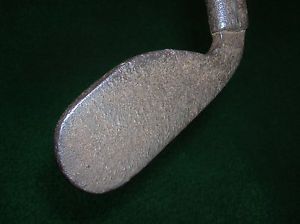
ALL ORIGINAL 1700s GOLF IRON--- SUPER RARE!!!This is a very rare, wood shafted golf iron that has been radio-carbon dated to circa 1760.One of the world’s premier radiocarbon-dating laboratories, the Rafter Radiocarbon Dating Laboratory in New Zealand, analyzed a wood fragment from this shaft and concluded that the wood dated to 1760, with accuracy of plus or minus 40 years (1720-1800).Radiocarbon dating measures organic lifespans from the moment that the organic material starts to decay---when the tree is first cut down, so the Rafter Radiocarbon dating reveals an accurate time frame for the year the tree was cut down that contained the wood of the shaft. This dating of the wood in the shaft is very significant. Wood contains about a 50% moisture content when a tree is first cut down and must be dried to approximately a 10% or less moisture content to stabilize potential building material, furniture, golf shafts, etc. so that shrinkage and warping are reduced or eliminated. This process takes one to two years unless it is shortened by heating or other methods. If the wood is dried too much longer than this two-year period, the moisture content can dip too low, making the wood brittle and prone to snap---like an old tree branch dried in the sun---perfect for firewood, but useless for a golf shaft. Once wood reaches the ideal moisture level, it is put to use and then sealed to maintain its moisture content and, hence, its maximum strength and stability. Properly sealed, the moisture content can be maintained for centuries (though the carbon decay continues unaffected). For this reason, wood is used within a couple of years of the tree being cut down. In conclusion, the radio-carbon dating of the wood of the golf shaft provides an accurate determination not only of the time frame during which the tree was cut down but also of the time frame of the manufacture of the golf club itself. This radio-carbon dating documentation is included in the purchase.This early club’s design is quite crude: the hosel is extra-long and very thick with heavy oxidation to the metal of the clubhead. The thick wood shaft is still tight to the clubhead and, amazingly, in playable condition.The club itself is 35 1/2" long and weighs 24 ounces. The heel to toe length of the clubhead is 4 1/2" and the width of the blade is 3/16". The hosel is 9" long with a circumference of 3 1/4" and is pinned in two positions, one high and one low. The clubhead is a separate piece of metal from the hosel. The club has a lie angle of 62 degrees with 16 degrees of left-handed loft. The shaft tapers from round at the hosel to square at the grip. There is a "V" cut into the grip indicating the correct placement of the right hand above the left on the wood shaft. See the pictures of how this works with the left-handed "baseball-style" grip, which was used at the time this club was played. Of course, few clubs of this vintage have survived the ravages of time. Knowledgeable collectors often estimate the number of pre-1800 clubs in the world at fewer than 25. Most of these clubs are in museums or private collections and they very rarely become available for purchase. Nearly all of these clubs are of Scottish manufacture with a very distinctive, squared-off toe. This club is quite different with its rounded toe, extra-long hosel, and thick shaft. We know golf was played in the Americas in the 1700s in both South Carolina and New York. Shipping records from the Scottish port of Leith show that a shipment of balls and clubs reached Charleston, South Carolina in the 1740s and there is a British military journal article and an ad from a New York newspaper that documents play on Long Island,