299 $
Description
| Club Type: | Putter | Dexterity: | rh |
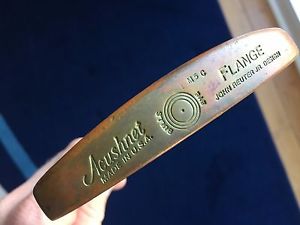
| Brand: | Titleist | Model: | Flange |
| Club Size: | 35 | MPN: | Does Not Apply |
| UPC: | Does not apply |
Titleist Golf Acushnet Bulls-eye Flange Putter 35" Fluted Steel Shaft Originali borrowed this from another listing but great info
| PUTTERS OF DISTINCTIONA Guide to Classic PuttersBULLSEYE PUTTERSThe man behind the bullseye putter was John Reuter, Jr. His design came to fruition around 1940. In 1958, the rights to the name and the design were sold to Acushnet (Titleist).Most bullseye putters are a blade style made of a soft brass head (some are aluminum and brass combination mallets or semi-mallets). It is estimated there have been more than 400 different Bullseye configurations offered over the years when styles, lengths, lies, grips and head materials are all considered. Over the years, the mixture of the brass in the heads changed from batch to batch. Some of the heads have a very yellowish coloration while others are a darker brown. Generally, the lighter the color the softer the material.All bullseye putters are marked with a bullseye on the sole of the putter near the toe with the Bulls and Eye being separated by the bullseye itself. The early bullseye stampings are quite large, often larger than the sole they are stamped on. The more recent bullseyes fit comfortably on the sole of the putter.Bullseye putters are "center-shafted" with the hosel located more than one third of the way between the distinctive hooked heel and the toe. This shaft placement allows the weight of the overall putter to be properly distributed. A collector will often find a non-factory sight line cut on the top line of a Bullseye halfway between the hosel and the toe. While this sight line detracts from the value of the putter, it is also positioned in the wrong place. The sweet spot on the bullseye is located near the hosel and not at the center of the blade. When a ball is positioned properly on the face of a Bullseye it almost appears to nestle at the end of the shaft next to the hosel.Almost all shafts used in Bullseyes were fluted and flared. Some of the earlier models can be found with non-fluted flared shafts and in the hosel shafts (Pro Feel) were made for one year. There are six flutes 2 and 3/8 inches long on most Bullseyes (some of the earliest models can be found with flutes over 4 inches). Grips on Bullseyes were leather with flat fronts and either a paddle type (now illegal) or more slender variety.The earliest Bullseyes (pre-Acushnet no model number) were stamped with a large bullseye, John Reuter, Jr., and Pat. Pending. As the number of different available models increased, the model number stampings (discussed later) were also placed on the sole along with the above stampings (pre-Acushnet with no model numbers).After Acushnet purchased the rights to Reuter's designs Acushnet was added to the sole of the putters with the above mentioned stampings. For a brief period after the granting of the Bullseye patent the stampings remained the same as those just mentioned except the Pat. Pending was deleted and a® was added below the large bullseye. | |
| The next series of Bullseyes were stamped John Reuter, Jr., Made In U.S.A., the model number, Acushnet, a smaller bullseye with a®, and a replica of the distinctive Bullseye head shape with a ®. The shafts on the next series of Bullseyes were changed to a straight taper fluted shaft and designed by was substituted for Made In U.S.A. on the sole. More recent Bullseye putters, while still playable, do not currently have a collector following and will not be discussed.As mentioned earlier, over 400 different Bullseye putters have been offered over the years. Out of this multitude of offerings the pre-Acushnet no model number, and three other models, appear to have the greatest collector and playability interest. As with so many other collectible golf clubs, older is deemed better. Thus, the pre-Acushnet no model numbers carry the highest value with the other pre-Acushnet and Pat. Pending models also having a higher value.The no model number pre-Acushnet putters are wide, heavy blades with either rounded or squared toes. The other three desirable models are the Old Standard, Standard and Standard Flange. The Old Standard and the Standard are the traditional basic Bullseye blade design, the Old standard having a squarer toe and top line and the Standard having a rounder toe and top line. The letters stamped on the sole designating these two models are OS (Old Standard) and STD (Standard). Sometimes an additional letter or letters - L (light) -H (heavy) or MH (medium heavy) will be stamped after the OS or STD to indicate the relative head weight of the putter. The Flange model (FL stamping) is similar to the Standard model except a small flange has been added to the back of the blade and the hosel is slightly more offset.The additional letters and numbers found on Bullseye putters indicate the lie (F for flat, M for medium and U or UP for upright), the length (4, 5 or 6 for 34", 35" or 36") and the type of grip (S for standard leather and P for the wide leather paddle). |