499 $
Description
| Brand: | Ping | Shaft Material: | Graphite |
| Model: | Anser Forged | Dexterity: | Right-Handed |
| Club Type: | Iron Set | Gender: | Men |
| MPN: | Does Not Apply | Flex: | Stiff |
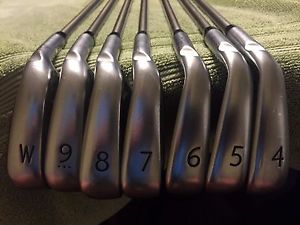
These are exceptional condition 2013 PING ANSER FORGED irons:Golf WRXS Editor Review
By Zak Kozuchowski
GolfWRX Managing Editor
Background:
In golf, Ping is known as a company that produces high-quality cast irons for golfers of all ability levels – everyone from high handicappers to 2012 Masters champ Bubba Watson. Despite the fact that five of the PGA Tour’s Top-10 ranked golfers in Greens in Regulation in 2012 used cast irons, some golfers are convinced that cast irons are inferior to irons that are forged.
While it is unfair to say that cast irons are always inferior to forged irons, cast irons generally have two distinct drawbacks. First, they often feel harsh at impact when compared to forged clubs, which tend to produce a softer feel. Cast irons are also tougher to bend, which can make it hard for golfers to dial in their lofts and lie angles.
Ping recognized the desire of many golfers to play forged irons, which is why the company released its first forged iron in decades in 2011, the Anser Forged. The irons were smaller than most Ping cavity back irons, which made them visually appealing to golfers who preferred the look of a compact iron at address. They also offered the softer feel that forged iron fans wanted
As expected, the Anser Forged were most popular in Japan and Asia, areas where forgings have a much broader appeal. But they were also well received by a small crowd of U.S. golfers who were anxious to finally try a modern forged iron from Ping. Ping received feedback, however that the average golfer had difficulty hitting the Anser Forged long irons high enough for them to be effective. This made the clubs suitable for a very small group of golfers – players who wanted a compact forged iron but didn’t need help hitting the ball higher.
In an effort to broaden the appeal of the Anser Forged, Ping re-engineered the irons for 2013. And they set the bar high, setting out to make “the ultimate forged iron.” Like the previous model, the new Anser Forged irons come with a steep price tag (expect to pay between $1300 and $1500 for a stock set). But if you can stomach the cost, you’ll have a set of irons that blend good looks and performance as well as any forged iron available.
Better looks and forgiveness?
The new Anser Forged are longer and more forgiving than the previous Anser Forged irons, especially in the long irons. Engineers made the soles of the long irons wider, which according to Ping senior design engineer Marty Jertson is the easiest way to make an iron fly higher.
But the added sole width came at a cost. Many good players hesitate to play an iron that has a visible sole at address. On the 2011 Ping Anser irons, golfers could only see the top line of the irons at address. But in the 2013 model, the sole is visible behind the top line on the 3 and 4 irons.
*2011 Anser Forged 3 Iron (Left) and the 2013 Anser Forged 3 Iron (right)
Engineers also added more offset to the long irons, another visual aspect that some good players can find unappealing. Offset is the space between the forward portion of the hosel and the front of the clubface. For many good golfers, offset can be a bad word. This is because the more offset a club has, the higher a shot will fly, which can cause problems for good golfers who like to hit low shots.
“The more offset you put on the club, the more the clubhead wants to catch up with the shaft,” Jertson said. “[During the downswing] the head is lagging behind the shaft, but right at impact the head kicks forward and starts to lead the shaft. The offset increases initial launch angle.”
The long irons just don’t have more offset, they also have larger heads to make them more forgiving. Good players might balk at the looks of the revamped 3 and 4 irons, but once they hit them their aesthetics will become less important. Players tempted to replace their long irons with hybrids likely won’t need to with 2013 Anser Forged. The 3 and 4 irons have the distance and forgiveness of many hybrids, but offer the trajectory control and soft feel of a forged iron.
The larger size of the 3 and 4 irons are a special case, however. Jertson and his team felt the extra bulk was worth the added performance. But the rest of the 2013 Anser Forged irons get progressively smaller and have less offset throughout the set. That’s because there are plenty of ways for engineers to add forgiveness without adding bulk.
Big forgiveness, small clubhead
Contrary to what many good golfers believe, thick toplines serve a purpose greater than adding visual confidence at address for less-skilled players. Just as heel-toe weighting adds forgiveness to shots hit on the heel and toe, weight above and below the sweetspot adds forgiveness to shots hit in those areas as well. That’s why Ping thickened the toplines of the Anser Forged irons. But unless you took a caliper and measured the toplines, you wouldn’t know they were any thicker. That’s because Ping engineers shaped the topline in such a way that they could hide mass underneath it. This makes the revamped irons more visually appealing to good players and adds better performance on mishits as well.
Jertson said that all Ping irons are designed to provide maximum forgiveness for their size. , engineers added tungsten weights and the strategically placed bars in the cavity of the irons that add forgiveness and tune the center of gravity. But because the 2013 Anser Forged Irons are larger than the S56 irons, they were able to add forgiveness on a larger scale.
*2011 Anser Forged 7 Iron (left) vs. 2013 Anser Forged 7 Iron (right)
Each of the 2013 Anser Forged irons have an enormous tungsten sole weight that moves the center of gravity lower and deeper for faster ball speeds. The bars in the cavity are also specialized for each iron -- on the long irons, they are thinner and extend horizontally for a lower center of gravity. On the short irons, engineers made the bars thicker and more vertical. This makes them more forgiving on shots hit above and below the sweet spot and helps golfers flight the ball as well. All together, the sneaky thick toplines, tungsten soles and strategically placed bars add a huge amount of forgiveness, making the Anser Forged irons play much more forgiving than their sizes indicate.
Miguel Angel Jimenez became the first to win with the 2013 Anser Forged irons at the UBS Hong Kong Open in November 2012 and Hunter Mahan put the irons in his bag at the World Challenge two weeks later. Both players were previously playing the smaller, less-forgiving S56 irons. That's a testament to how good these irons look, even to the discerning eye of a top tour pro.
Looks: The 3 and 4 irons are a bit on the chunky side, but the 5 iron though pitching wedge look like forged cavity back irons should. While the irons get smaller as they work down the set, they are all larger than blades. But they're not too much bigger than the S56 and forged cavity back irons aimed at better players.
Playability and Performance: This is where the Anser Forged Irons shine. They're not too much bigger than the top tier of players irons, but they are much more forgiving. The tungsten weighting and angled bars offer substantial forgiveness and fine-tuned trajectory throughout the set without added bulk.
Flight and distance: Long irons launch easy and won't balloon for better players with the right shaft. The mid-and-short irons offer workability, and are able to be flighted when necessary. Distance won't be a problem with these. No problems working the ball, either.
Feel: The irons are forged from 8620 carbon steel, but don't feel as soft as other forgings because of their multi-material construction and their deeply milled cavities. It's a "squish" feel at impact -- an improvement over the clicky sound of most Ping irons, but definitely not the buttery feel that some forged irons produce.
Cost: The key to getting more forgiveness out of a small, forged clubhead like the new Anser Forged is the deep cavities in the back of the club. They give engineers the ability to redistribute weight in the most optimal places. It took multiple forging and milling steps to get the Anser Forged’s 8620 steel as thin as necessary in certain areas, which is why they're so expensive.
Bottom Line: If you want one of the highest-quality, highest-performing forged irons on the planet, these irons are for you. They don't feel as good or look as good as the Anser Forged irons, but they're slightly more playable thanks to a little more offset and a larger blade size
white dot is 3* UP - as they are forged you can easily bend to whatever lie angle you desire if you feel the need to change. My cost new 3 years ago was >$1400 after tax - I am an avid golfer who replaces my sticks every three years which is only reason I am changing. all faces are excellent - I have taken 2 face pics - one of wedge which I use the most and practice with lots - you'll see it shows the most wear but still very little and the milling lines can still be seen on the face so still GOOD (7/8 on 10) condition. The other pic is face of the 9 iron (all other irons are at least as good as it) - it is clearly a 9/10 still as seen in pics. grip just changed earlier this year in MAY before I bought new just recently - I took close up and you'll see still exceptional like new (again at 9 / 10 scale) - probably use 20 rounds this year is all. These are PINGS standard size "white" grips all irons are matching and ping skew provided but hard to see in picture I tookI am also providing 2 items below which provide some details on shaft upgrade I installed and ANSER club review by most :
- information on Aerotech GRAPHITE shaft upgrade I installed on these (this is a 37 per club upgrade) - screen print below from Aerotech website so you can see on own if desired. I choose this graphite shaft as best match to steel shafts and many pros playing - it's lighter so you get slightly higher club speed for more distance AND graphite absorbs shock of ball striking more so less harsh on your body . - review of these fabulous clubs by Golf WRXS - one of best sites for independent club reviewsBELLINGHAM, Wash. – Since the successful launch of the SteelFiber® i125 wedge shaft last year, Aerotech has been bombarded with requests for a matching iron shaft. Today, the wait is over and Aerotech is proud to introduce the all-new SteelFiber i125 iron shaft, a ‘pro-weighted’ composite design that delivers superior playability with the consistency and accuracy of steel.“We’re excited that SteelFiber i125 shafts are now part of our product line,” says Chris Hilleary, president of Aerotech Golf. “After we introduced the i125 wedge shaft, the number of requests we received for matching irons was staggering. The new SteelFiber i125 graphite shaft is designed for players who prefer the weight of a steel shaft, but who also want the vibration dampening benefits and pinpoint accuracy of the SteelFiber design.”Hilleary explains that the SteelFiber i125 iron shaft is unique among other heavier composite shafts because the additional weight is not achieved by adding more graphite – which makes shaft walls too thick and creates a ‘boardy’ feel – but rather by adding more metal fiber which has five times the density (weight) of graphite. This minimizes the increase in wall thickness and maintains the shaft’s playability with an incredibly stable feel and no harsh vibrations.The i125 shaft is a 0.370-inch parallel design. Like all designs by Aerotech is a constant weight configuration so individual shafts within the iron set weigh exactly the same regardless of length. SteelFiber i125 shafts weigh 125 grams and are available in stiff and x-stiff flexes. MSRP $37.SteelFiber shafts feature a high-modulus graphite core and more than 59 miles of steel fiber covering the surface of each shaft, providing golfers with the power of graphite and the stability of steel. While the shaft’s graphite core provides vibration dampening, increased clubhead speed and maximum distance, the steel fibers produce a optimum weighting for a solid feel at impact and add stability and control for pinpoint accuracy. Originally developed for irons the SteelFiber technology now enhances the performance of drivers, fairway woods, hybrids, irons and wedges.Aerotech Golf specializes in uniquely engineered, performance-enhancing golf shafts and has supplied shafts to such renowned golf club manufacturers as Cleveland Golf, Adams Golf, Fenwick, Srixon, Lynx, Zevo and Pure Spin among many others. By launching its own branded golf shafts in 2002, Aerotech became known as a producer of some of the most innovative, high-quality golf shafts on the market.
By Zak Kozuchowski
GolfWRX Managing Editor
Background:
In golf, Ping is known as a company that produces high-quality cast irons for golfers of all ability levels – everyone from high handicappers to 2012 Masters champ Bubba Watson. Despite the fact that five of the PGA Tour’s Top-10 ranked golfers in Greens in Regulation in 2012 used cast irons, some golfers are convinced that cast irons are inferior to irons that are forged.
While it is unfair to say that cast irons are always inferior to forged irons, cast irons generally have two distinct drawbacks. First, they often feel harsh at impact when compared to forged clubs, which tend to produce a softer feel. Cast irons are also tougher to bend, which can make it hard for golfers to dial in their lofts and lie angles.
Ping recognized the desire of many golfers to play forged irons, which is why the company released its first forged iron in decades in 2011, the Anser Forged. The irons were smaller than most Ping cavity back irons, which made them visually appealing to golfers who preferred the look of a compact iron at address. They also offered the softer feel that forged iron fans wanted
As expected, the Anser Forged were most popular in Japan and Asia, areas where forgings have a much broader appeal. But they were also well received by a small crowd of U.S. golfers who were anxious to finally try a modern forged iron from Ping. Ping received feedback, however that the average golfer had difficulty hitting the Anser Forged long irons high enough for them to be effective. This made the clubs suitable for a very small group of golfers – players who wanted a compact forged iron but didn’t need help hitting the ball higher.
In an effort to broaden the appeal of the Anser Forged, Ping re-engineered the irons for 2013. And they set the bar high, setting out to make “the ultimate forged iron.” Like the previous model, the new Anser Forged irons come with a steep price tag (expect to pay between $1300 and $1500 for a stock set). But if you can stomach the cost, you’ll have a set of irons that blend good looks and performance as well as any forged iron available.
Better looks and forgiveness?
The new Anser Forged are longer and more forgiving than the previous Anser Forged irons, especially in the long irons. Engineers made the soles of the long irons wider, which according to Ping senior design engineer Marty Jertson is the easiest way to make an iron fly higher.
But the added sole width came at a cost. Many good players hesitate to play an iron that has a visible sole at address. On the 2011 Ping Anser irons, golfers could only see the top line of the irons at address. But in the 2013 model, the sole is visible behind the top line on the 3 and 4 irons.
*2011 Anser Forged 3 Iron (Left) and the 2013 Anser Forged 3 Iron (right)
Engineers also added more offset to the long irons, another visual aspect that some good players can find unappealing. Offset is the space between the forward portion of the hosel and the front of the clubface. For many good golfers, offset can be a bad word. This is because the more offset a club has, the higher a shot will fly, which can cause problems for good golfers who like to hit low shots.
“The more offset you put on the club, the more the clubhead wants to catch up with the shaft,” Jertson said. “[During the downswing] the head is lagging behind the shaft, but right at impact the head kicks forward and starts to lead the shaft. The offset increases initial launch angle.”
The long irons just don’t have more offset, they also have larger heads to make them more forgiving. Good players might balk at the looks of the revamped 3 and 4 irons, but once they hit them their aesthetics will become less important. Players tempted to replace their long irons with hybrids likely won’t need to with 2013 Anser Forged. The 3 and 4 irons have the distance and forgiveness of many hybrids, but offer the trajectory control and soft feel of a forged iron.
The larger size of the 3 and 4 irons are a special case, however. Jertson and his team felt the extra bulk was worth the added performance. But the rest of the 2013 Anser Forged irons get progressively smaller and have less offset throughout the set. That’s because there are plenty of ways for engineers to add forgiveness without adding bulk.
Big forgiveness, small clubhead
Contrary to what many good golfers believe, thick toplines serve a purpose greater than adding visual confidence at address for less-skilled players. Just as heel-toe weighting adds forgiveness to shots hit on the heel and toe, weight above and below the sweetspot adds forgiveness to shots hit in those areas as well. That’s why Ping thickened the toplines of the Anser Forged irons. But unless you took a caliper and measured the toplines, you wouldn’t know they were any thicker. That’s because Ping engineers shaped the topline in such a way that they could hide mass underneath it. This makes the revamped irons more visually appealing to good players and adds better performance on mishits as well.
Jertson said that all Ping irons are designed to provide maximum forgiveness for their size. , engineers added tungsten weights and the strategically placed bars in the cavity of the irons that add forgiveness and tune the center of gravity. But because the 2013 Anser Forged Irons are larger than the S56 irons, they were able to add forgiveness on a larger scale.
*2011 Anser Forged 7 Iron (left) vs. 2013 Anser Forged 7 Iron (right)
Each of the 2013 Anser Forged irons have an enormous tungsten sole weight that moves the center of gravity lower and deeper for faster ball speeds. The bars in the cavity are also specialized for each iron -- on the long irons, they are thinner and extend horizontally for a lower center of gravity. On the short irons, engineers made the bars thicker and more vertical. This makes them more forgiving on shots hit above and below the sweet spot and helps golfers flight the ball as well. All together, the sneaky thick toplines, tungsten soles and strategically placed bars add a huge amount of forgiveness, making the Anser Forged irons play much more forgiving than their sizes indicate.
Miguel Angel Jimenez became the first to win with the 2013 Anser Forged irons at the UBS Hong Kong Open in November 2012 and Hunter Mahan put the irons in his bag at the World Challenge two weeks later. Both players were previously playing the smaller, less-forgiving S56 irons. That's a testament to how good these irons look, even to the discerning eye of a top tour pro.
Looks: The 3 and 4 irons are a bit on the chunky side, but the 5 iron though pitching wedge look like forged cavity back irons should. While the irons get smaller as they work down the set, they are all larger than blades. But they're not too much bigger than the S56 and forged cavity back irons aimed at better players.
Playability and Performance: This is where the Anser Forged Irons shine. They're not too much bigger than the top tier of players irons, but they are much more forgiving. The tungsten weighting and angled bars offer substantial forgiveness and fine-tuned trajectory throughout the set without added bulk.
Flight and distance: Long irons launch easy and won't balloon for better players with the right shaft. The mid-and-short irons offer workability, and are able to be flighted when necessary. Distance won't be a problem with these. No problems working the ball, either.
Feel: The irons are forged from 8620 carbon steel, but don't feel as soft as other forgings because of their multi-material construction and their deeply milled cavities. It's a "squish" feel at impact -- an improvement over the clicky sound of most Ping irons, but definitely not the buttery feel that some forged irons produce.
Cost: The key to getting more forgiveness out of a small, forged clubhead like the new Anser Forged is the deep cavities in the back of the club. They give engineers the ability to redistribute weight in the most optimal places. It took multiple forging and milling steps to get the Anser Forged’s 8620 steel as thin as necessary in certain areas, which is why they're so expensive.
Bottom Line: If you want one of the highest-quality, highest-performing forged irons on the planet, these irons are for you. They don't feel as good or look as good as the Anser Forged irons, but they're slightly more playable thanks to a little more offset and a larger blade size